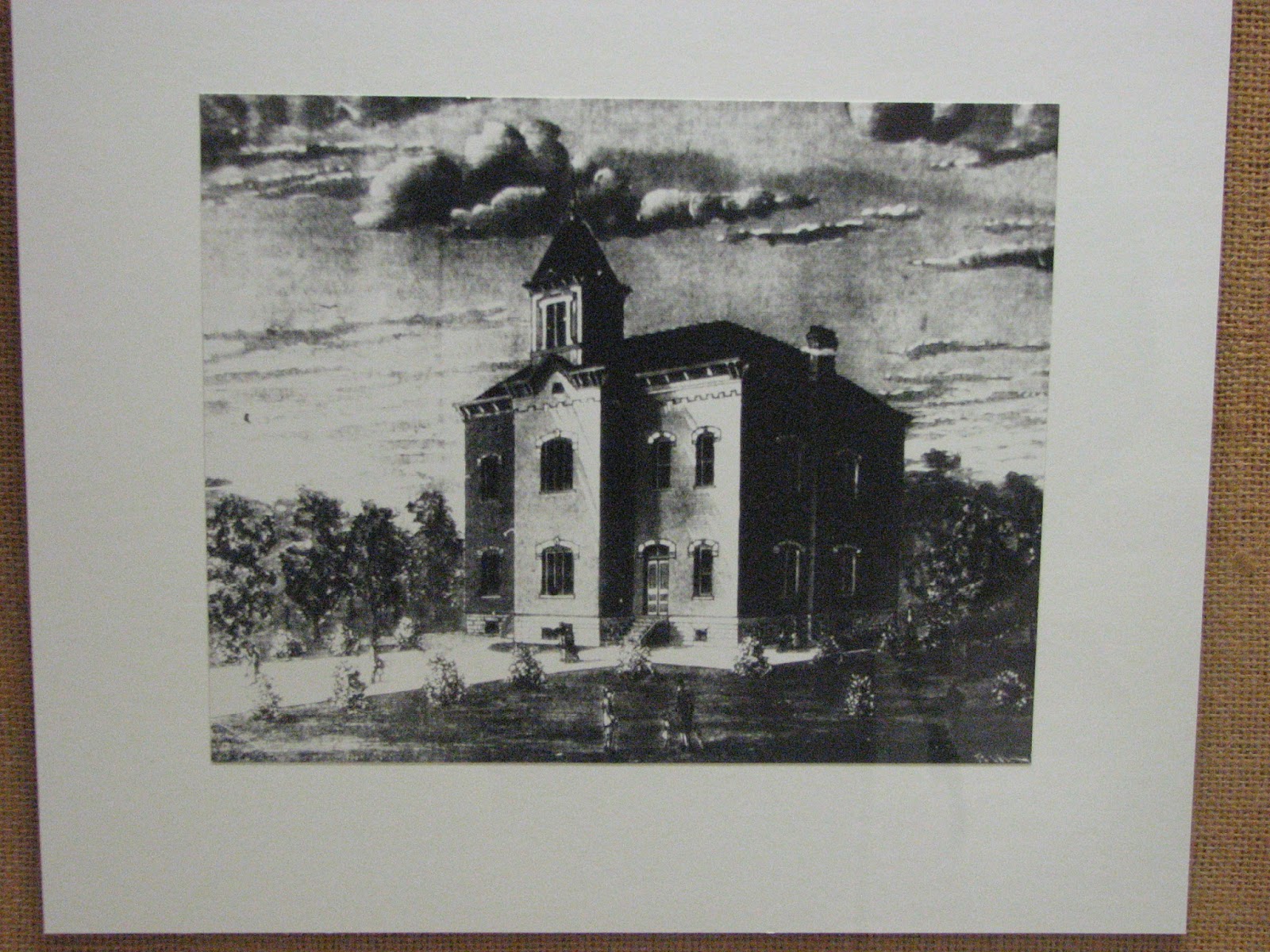
Friday, September 27, 2013

Langley, Kansas, an Ellsworth County dead town

On a cool, crisp fall day, I found Langley.
There wasn't much left of this once vibrant stop in the road.


Only a few homes dot the once bustling main drags, which are separated by an overgrown railroad bed. A woman works around her mailbox and barking dogs greet the few passing cars.
Down a dirt road, at what would have been the outskirts to town, is the cemetery.
I stopped by Marquette's hardware store, where owner Max Buffington recalled  to me his first trip to the elevator hauling a pickup truckload of grain in the early 1950s.
“I was 9 years old,” Buffington said, noting he was a little small to drive a truck, but the elevator man helped him get stopped.
Langley is no longer the vibrant town of his childhood, he said, nor is it even a fragment of its size when his great-grandfather, George Buffington, first settled the area in 1898, establishing a cattle ranch.

Pappy Helms' old store. It was used in a scene for the movie Ace Eli and Roger of the Skies filmed in the 1970s starring Cliff Robertson.


The 1880s were a prosperous time in Kansas history as more pioneers moved west and towns began to form along the unplowed landscape. Langley was like many prairie towns. The Missouri Pacific Railroad was building thousands of miles of track through Kansas and needed water stations or tank stops every 10 miles for the engines.
A man named Langley and another man named McCracken decided to invest in land, hoping to cash in on the area they thought might someday be a important shipping point.
They formed Langley on 38 acres of land purchased from area farmer Job Fowler, a homesteader who had first come to the country in 1873.
According to one account documented at the Ellsworth County Historical Society, Langley soon realized he wasn’t going to get rich quick. He learned the railroad, the Union Pacific, was going to go through Kanopolis instead.
“All they got out of it was to have a town named after them,” Langley’s daughter, Jane Langley Board, wrote in a letter to the Langley City Council in the 1950s or 1960s, although the town was never incorporated or had a city council.
Langley, however, would become a train pit stop, forming about 1886 when the Missouri Pacific Railroad passed through southeast Ellsworth County, according to an article by Judy Lily for a local newspaper.
At first, the town was just a depot and two dugouts. A post office was established in April 1887 with Joseph Byrne as the first postmaster, according to the Kansas State Historical Society.
The town soon began to grow. There was a general store owned by J.R. Adams. It was destroyed by fire in 1902, according to a transcript of a talk given by John Hughes in 1984, a man who was raised in the Langley area.
Hughes reported that Job Fowler then built a large two-story building with an upstairs hall for entertainment, as well as groceries. A locker plant was later added on the building.
Phillip Fredrick operated a hardware and lumber store, which also had a full line of cured meats, coal, farm machinery, along with lumber and hardware, Hughes said.
The Methodist Church was built in 1894 and a cemetery was established. There also were stockyards and a blacksmith. A milling company in Marquette had an elevator.
Another historical account from the Ellsworth Historical Society states Langley had a hotel, two garages, a livery stable, creamery and barber shop.
Buffington said he remembers a man named Pappy Helms running a small grocery and filling station on the northeast edge of town.
And, while unincorporated, Langley, at one time, had more than 300 residents, according to the county historical society documentation.

The Langley Cemetery still reminds folks the name of the area.

A few stone remnants - not sure what was once in this location.

A view from one of the main streets of Langley. A few homes are on the left side of the photo. To the right is the old railroad bed.

Max Buffington holds wood from the old Langley hardware and lumber.

Wood from the Langley Lumber

Monday, July 22, 2013

Yaggy, Kansas - A Reno County ghost town

On a July afternoon, I took a tour of what was left of the town of Yaggy with Dorothy Shultz Wall. Wall lived at the former town and orchard for six years - 1939 to 1945. Her father worked for the Yaggy family.

What we found was little. There are a few homes, including the white Yaggy plantation homes, which are on private property. Her childhood home is gone. Fields were thousands upon thousands of apple and catalpa trees once grew is now planted to wheat. Drought took the trees in the 1930s.

Little remains of Yaggy - it died, it seems, with the trees.


Town with 4 names
Yaggy is a town that had four names.
It was Salem in 1872, according to the book "Early Ghost Towns, Post Offices and Hamlets in Reno County, Kansas," by local resident Bert Newton.
The Reno County town was a station on the Atchison, Topeka and Santa Fe Railroad - located near the intersection of Yaggy Road and Nickerson Boulevard. It is believed that the railroad changed the name to Bath following a bad train wreck in that area on Oct. 2, 1882.
According to Newton, a Hutchinson News article from that date told of a mail train having to run onto a sidetrack at Salem, waiting for the Cannon Ball to pass. The switch, however, was incorrectly turned, allowing the Cannon Ball to tear "along at the rate of 40 miles an hour, to crash into the mail train."
Newton recorded that both engines and six cars were demolished and the jolt sent the "great crowd of passengers flying hither and thither, jammed up, injured, scared, crying, cursing."
William Cutler's "History of Kansas," published in 1883, still listed the town as Salem.
But the town would soon change again from Bath to Fruit Valley and, eventually, Yaggy, thanks to a man named Yaggy who saw promise in landscape with a bountiful underground water table.

 
Ideal for an orchard
Levi Walter Yaggy was one of the best known publishers in the United States. He owned Western Publishing House in Chicago, which had 17 branches and a thousand agents across the country, according to "Reno County, Kansas: Its People, Industries and Institutions," written by Sheridan Ploughe.
Yaggy was a mechanical genius who had patents on a few innovations, including an adding machine and a stubble turner, according to Ploughe.
But it was on a goose-hunting trip to Kansas in 1884 that he started Reno County's produce legacy. "L.W." observed a well being dug on the Thomas Parker Ranch.
"He found the water table was only two feet down, and to him that was a huge finding. Water is always a problem," said Laura Krantz Reed about her great-grandfather.
Realizing that the underflow of the Arkansas River would provide good access to water, L.W. bought the entire Parker estate - 1,350 acres - and planted catalpa and apple trees - the catalpa used to make fence posts and railroad ties.
By 1893, the plantation was blossoming and L.W. made arrangements to have the name of Bath changed to Fruit Valley, according to Newton's book. He thought it was more descriptive of the area.
An 1895 Rand McNally map labels the area as such, although another map from that time lists it as Bath.
But the post office didn't accept the name Fruit Valley, according to the Kansas State Historical Society. They dubbed the railway station and community center as Yaggy when the post office opened in January 1900, before closing that June.
The post office reopened a year later, but only for three months.


Edward and Laura
While the orchard began under L.W. Yaggy, his son, Edward, continued to grow into the national produce market.
Edward came to the area in 1897 for a three-month stay while his father was in Europe, according to an Oct. 30, 1988, story in The News. He stayed 40 years.
Reed said her grandmother, also Laura Reed, a concert violinist from a prominent pioneering Kansas City family, had come to visit a friend at Forsha Ranch. Edward was at the same event.
The two married in December 1905, and Laura continued to make concert appearances, playing with the New York Philharmonic. She also was involved in, and even led, the Reno County suffrage movement.
The Yaggy plantation continued to grow. In the early teens, the farm had 500 acres of catalpa trees, as well as 808 acres of apple trees, with apples shipped all over the nation.
"It's one of the most profitable production plantations of the sort in the country," Ploughe wrote in his book. "There are no fewer than one million catalpas growing on the place and 50,000 apple trees, 600 acres of which latter are now bearing and the rest coming into bearing."
In 1915, Edward Yaggy sold 210,000 bushels of apples - the principal varieties being Jonathan, Grimes Golden, Wine Sap, Roman Beauty and York Imperial. He added cowpeas, potatoes and sweet potatoes to the offerings. Yaggy soon became the largest shipping point for fruit between the Missouri River and California.
"It was the largest apple orchard under one fence in the United States," Reed said, adding that the red warehouse had 18,000 square feet used for grading and storing fruit.
The plantation employed 300 men during the busy season, and it had 30 employees full-time.

These photos are courtesy of Dorothy Wall. 


The Edward Yaggy plantation. His father came to the area in the 1880s and discovered it was perfect for an orchard.
Turkeys at Yaggy

Apples from Yaggy

Dorothy Shultz Wall's home at Yaggy. It has been torn down.

Yaggy School.Dorothy Wall believes the photo was taken around 1920. Her father is in the picture. He was 14.

Here's a cool old photo of the apple orchard. Dorothy Wall's grandfather is on the white horse. He was the orchard overseer.

Flood at Yaggy in the early 1940s.

Friday, May 24, 2013

Go West Young Man - Greeley County ghost towns

It has been more than 150 years since the New York newspaperman told easterners to "Go West." Yet, in Greeley County, Horace Greeley's name lives on.

The county seat is named after his newspaper. The county and a town both carry his name. There are ghost towns, as well, influenced by the New York Tribune publisher, including the communities of Whitelaw and Reid - named after an editor - and Hector, after his dog.

In 1841, Greeley established the Tribune, which became the leading national newspaper of its time. He helped form the Republican Party and, as an abolitionist, he fought for Kansas' entry into the Union as a free state. Greeley ran against Ulysses S. Grant in 1872 for the presidency, but lost, dying before the votes were even counted.

Still, Greeley's devotees named towns, streets and counties after him. That included W.C. Gerard. Gerard founded Tribune in 1885, which was originally known as Chappaqua and located a mile north of present-day Tribune. But the name changed shortly after its founding.

"He was never out here," Nadine Cheney, curator of the Horace Greeley Museum, said of the county's namesake. Yet people like Gerard coming from the east were largely influenced by Greeley and his newspaper.

Hector - four miles north of Horace there was Hector, named after Horace Greeley's dog. In April 1886, C.T. Thompson began publishing the Hector Echo, Cheney said. Hector also had had two hotels, two stage lines, a lumberyard, hardware store, a land-and-loan company and good water.

In December 1885, it got a post office. A newspaper chronicling the blizzard of 1886 reported that newly named postmaster George Chapman didn't assume his post, as he died in the blizzard.

Even with all of these new businesses, in the summer and fall of 1886 the town of Hector declined and was transplanted to Tribune.

It became the first ghost town in Greeley County as a result, according to Fort Hays State University.

Greeley Center  -- a town north and west of present-day Horace, was the county's second ghost town. Named after Horace Greeley, the Greeley Town Co. formed in October 1885, according to Fort Hays.

It had a newspaper, the Greeley County Gazette, edited by the Wilbe brothers from Hutchinson, Cheney said. The town had the Greeley House Hotel, a livery stable, a grocery store, blacksmith, general store, lumberyard and drugstore.

Cheney said the newspaper reported 75 new arrivals in one day's time, but, in June 1887, the boom ended.

Others had already started the town of Horace in 1886 and Greeley Center lost a significant number of businesses to Horace, Fort Hays reported. By June 1887, the Denver, Memphis and Atlantic Railroad put tracks through Horace and left Greeley Center unable to continue its growth.

"The last remnants of Greeley Center were plowed and cleared away by 1894, never to be seen again," according to Fort Hays. "A lot of the buildings moved to Horace, all planning on being by the railroad tracks. But they did not come through Hector and they did not come through Greeley Center."

Colokan - on the Colorado/Kansas line - Colokan didn't have a tie to Horace Greeley, it was settled by those seeking land to the east. It was located just off the Colorado/Kansas border, not far from the Colorado community of Towner.

According to Fort Hays, Civil War veterans from Illinois came and settled in Greeley County, forming what was known as a soldiers' colony. In 1887, the colony merged with the United Presbyterian colony, forming Colokan Town Co.

The first issue of the newspaper, the Colokan Graphic, edited by O.Q. McNeil, was published in October 1887, Cheney said. It advertised Robert Rockwell's new hotel and restaurant with meals at any hour. Colokan had a real estate office, notary public, a grocery and a blacksmith. The Denver, Memphis and Atlantic Railroad went through the town and the town of Towner. However, when Towner got the depot instead of Colokan, the latter folded.

Whitelaw - Reid Whitelaw Reid was an editor at the New York Tribune and a close friend to Greeley. He was on Republican incumbent Benjamin Harrison's presidential ticket as the vice president, although the duo lost. Thus, two towns are named after the man - Whitelaw and Reid.

Whitelaw had a post office from 1888 to 1890, according to the Kansas State Historical Society. And Cheney said it had an elevator and a few houses.

Residents at Reid, however, had bigger dreams.

Thinking it would be the county seat, the newspaper in Tribune moved to the newly formed town of Reid in 1887. The railroad line went 2 1/2 miles west of Greeley Center, which ultimately became the site of Reid. The town had 50 residents in June 1887.

Old Tribune, before the county seat election, eventually moved a mile south to catch the railroad, helping secure its place in the present day. In November 1888, Tribune was declared the county seat over Horace and Reid, with 420 votes in favor of Tribune, 202 votes in favor of Horace, and only 2 votes going to Reid.

When Tribune became the county seat, all the businesses from the different towns began to move their stores to Tribune, Cheney said. The moving of these businesses ultimately led to the demise of Reid.

In 1891, there were 26 people living in Reid, now called Astor by those residents. By 1897, the town became a ghost town and the town company eventually sold the land for $35.01 in 1901 to pay the back taxes on it.

Locals probably named Astor after John Jacob Astor, one of the richest men in the 19th century. Horace Greeley was a critic of the New Yorker, and a Greeley County illustrated map from 1897 depicts a man with dollar signs on his head.

"Reid/Astor faded into the Kansas background just like so many other settlements of the time period," Fort Hays reported.

Other towns tried to start, as well, including Ainsworth, Thelma, Locust, Youngsville, Hurt and Sidney. Each had a post office, but none of the towns lasted much past the 20th century.

Except for Horace and Tribune, the county's only incorporated cities, nothing remains of any of these ghost towns, Cheney said.

Cheney has trekked through every town site in the county, finding only fragments of life.

There are a few foundations at Astor. She has found broken glass, pieces of concrete and square nails.

"Wherever man goes, he leaves trash," she said.

Moreover, the county never saw the populations it did when these towns were thriving.

The 1890 census shows the county population at more than 2,600 inhabitants in 1887, according to "Kansas: A Cyclopedia of State History." It is unclear whether the county actually had that many people. Census numbers show dramatic drops after that, including just 1,200 people in 1890, and the population in 1900 dipped below 500 people.

In 2009, the U.S. Census estimated the county had 1,200 people - the smallest in Kansas.

It didn't take long for early-day farmers to realize that growing crops in the semiarid terrain wasn't easy. Some moved to Holly, Colo., Cheney said. Others went elsewhere.

"Some of them left for the Oklahoma (land) run," she said. "Many times they couldn't find water in Greeley County, and they seemed to move on."

Tuesday, May 21, 2013

Saratoga, Kansas - a video of Dorotha Giannangelo telling the story of the town


Here Here's a video of 91-year-old Dorotha Giannangelo - a Pratt County historian and author of five historical books about the county. She talked to me about the dead town of Saratoga, which was part of a 10-year battle Pratt County seat. Saratoga lost. Pratt won. And today, Saratoga is history. The story of Saratoga is one she learned from her father, J. Rufus Gray, who wrote the book “Pioneer Saints and Sinners.” But, Giannangelo notes, it is a story that has faded with time. Most who travel the paved road to the Kansas Department of Wildlife, Parks and Tourism’s operations office just a half-mile south of the Barkers’ farmstead would never know there ever was a town here that once supported nearly 600 people. There is no evidence left that they are driving on one of Saratoga’s main roads or that they go right by where Saratoga’s square once sat. And, yet, she adds, there are a few deep-rooted Pratt families who can’t forget the turbulent history, either. “There are still hard feelings,” she said, rattling off a few names of those still bitter 130 years later that the battle for the county seat didn’t go a different way.

Monday, May 13, 2013

Saratoga, Kansas - it died after losing election for the Pratt County seat

When a town dies, there is no funeral.

But at Saratoga's Summit Hill Cemetery, the wild Iris' still bloom. And perhaps, on occasion, someone remembers a loved one with flowers on Memorial Day.

I ventured here on a cold and rainy day, stopping by the Carter Barker home. His home is situated in where a platted town should be - but nothing remains of Saratoga, except for the 10-acre cemetery.

By the size of the cemetery, they had plans for a big community. But when Saratoga lost the county seat to Pratt, located just a few miles to the west, the town disappeared. I'll have a story in Sunday's Hutch News about the town and its death.
Dorotha Giannangelo has written five books on Pratt County history. She is a great source of information on Saratoga.

Besides the cemetery, there are a few brick remains of the school atop this hill by the trees.
Some of the things found around Saratoga that are on display at the Pratt County Museum.

Here's a rendition of the old flour mill.

Another pictorial shows the school.

Residents set aside 10 acres for the cemetery. They definitely expected to get the county seat honor.s Here's what it would have looked like. A quarter of the cemetery was designated for the town's African American settlers.
Some of the graves are cracked. Some have been stolen over the years.


The cemetery's condition isn't great. But a man named Price Gibbons set up a fund for upkeep before he died a few years ago.


The stone for Jane Martin rests against a tree.

I believe her name was Lizzie Eisenhour.

One of the few graves still standing - His name was Miles.


Tuesday, April 23, 2013

A few things on Saratoga, Kansas -a dead town in Pratt County

Source: Fort Hays State University


Saratoga, Kansas, once had aspirations to be the Pratt County seat.

Today, it is just a wheat field.

Here are a few things I've discovered while researching this story. I'll be heading to Saratoga Friday.

Click here for a link to whose buried in the little Saratoga Cemetery.

An excerpt from volume II of Kansas: a cyclopedia of state history, embracing events, institutions, industries, counties, cities, towns, prominent persons, etc. ... / 

There were a few settlers (in Pratt County) in 1876, but in 1877 over 100 families came, many of them from Iowa. The county was attached to Reno that year as a municipal township. The bogus organization was set aside in the fall of 1878, and in the spring of 1879 the citizens petitioned the governor for organization. A census taker was appointed and upon receiving the returns Gov. St. John issued a proclamation organizing Pratt county, with Iuka as the temporary county seat and the following temporary officers: County clerk, L. C. Thompson; commissioners, John Sillin, Thomas Goodwin and L. H. Naron. The election was held on Sept. 2nd, when the following officers were elected: County clerk, L. C. Thompson; clerk of the district court, Samuel Brumsey; probate judge, James Neely; treasurer, R. T. Peak; sheriff, Samuel McAvoy; county attorney, M. G. Barney; superintendent of public instruction, A. H. Hubbs; register of deeds, Phillip Haines; surveyor, J. W. Ellis; coroner, P. Small; commissioners, John Sillin, L. H. Naron and Thomas Goodwin.

For county seat there were three candidates, Saratoga, Iuka and Anderson. In the count the commissioners threw out three townships on account of irregularities. This gave the election to Iuka, but caused so much dissatisfaction that a recount was taken, including the votes previously thrown out. No candidate then had the majority and a new election was ordered. Anderson withdrew. The election was held Aug. 19, 1880. An attempt on the part of Saratoga to buy votes became public before the election, Iuka received an overwhelming majority and was declared the permanent county seat.
The next year some of the county officials were found guilty of swindling the county by issuing scrip illegally, in the two years after the county was organized they had taken nearly $75,000 or about $40 for every man, woman and child in the county. They were prosecuted and new officers elected. In the fall of 1885 there was another county seat election. The candidates were Iuka, Saratoga and Pratt. It was one of the most bitterly contested county seat elections ever held in the state. Saratoga had 546 votes and Pratt 324.

As the total number of voters at Saratoga was but 200 fraud was charged, the commissioners sustained the charges and declared Pratt the county seat. The matter was taken into the courts, and pending the decision the feeling ran high. The Saratoga and Pratt partisans were all armed and trouble was hourly expected. The Pratt men went to Iuka and forcibly removed the county records. On the way back they were attacked by the Saratoga men, who succeeded in capturing the treasurer's safe, which they took to their town. The next day Saratoga made an attack on Pratt in a fruitless effort to get the other county property.

By this time the more peaceable citizens asked the governor to send militia to restore order. Gov. Martin sent Adjt.-Gen. Campbell and Col. W. F. Hutchinson to the county. They stationed guards at both towns and allowed no one to carry arms. Finally the supreme court handed down its decision and ordered the records taken back to Iuka. Matters quieted down, but the county seat contest was not yet forgotten, and in Feb., 1888, a petition was presented to the commissioners asking for a special election to relocate the county seat.

The election was held on Feb. 29 of that year, and Pratt was the winning candidate. The question was settled at last.

Friday, April 12, 2013

Johnstown, Kansas, a McPherson Co. Dead Town

I went to Johnstown in late March 2013 after a reader suggested the little McPherson County hamlet. Today, there's nothing left, but still, it's fascinating to see the location where a former village once existed.

The Johnstown post office was established in 1883, according to the Kansas State Historical Society.

Johnstown had a creamery and a Lutheran church. A school was located not far away, as well. There even was a store, operated by the Larson family, which stayed in business until the turn of the century. Even a train went through the area and stockyards were established along it at Johnstown.
Herman Johnson, Paul "Corky" Malm’s grandfather, bought the Johnstown town site around 1903 – roughly 20 acres he purchased for $500. He even bought the Larson store, which was closed.  

“He owned the land, raised watermelons and was a trapper,” Malm said. “He traveled in an old Model T.”
Herman Johnson wrote an article for a national publication called Camp and Trail, which had articles on trapping. Malm’s copy does not have a date.

“The only game left here now is skunk, mink, coon, civet cat, opossum, muskrat and a few badger and coyote but they are getting scarce except the coyote, which is holding its own,” he wrote. “The otter and beaver is a thing of the past, and so are our game birds a thing of the past if they don’t enforce stricter laws to protect them. There are a few quail and prairie chickens left but they are few.”

Johnson wrote that he used fish for bait, if he could get it, as well as frogs, chicken ad rabbit.

“It must be fresh bait,” he said.

Malm said he grandfather also bred skunks and the skunk dens are still visible along Indian Creek near Kola Johnson’s home. Malm said his grandfather earned enough to support his mother and grandmother.

Johnstown is located in McPherson County between Lindsborg and McPherson, just off 81 Highway.


Today, however, little is left of the little McPherson County village. Kola Johnson said. The skunk dens are still along the creek. A stone in front of her home marks the last remains of the old general store. The railroad bed is still visible, too, the tracks ripped up years ago.
And there is the home that Kola Johnson lives in, the one her father was raised in, she said. They’ve remodeled it and added on to it over the years.
Johnstown still makes television radar maps, on occasion. It still graces a few back road Gazetters, as well.

Kola Johnson thinks this might have been a town well at one time. Today it serves as the concrete that holds the Johnson mailbox.

Around 1919, Herman Johnson built the home Kola Johnson now lives in – an inscription in concrete where the old cistern once stood still marks the date.
Herman Johnson was progressive, Malm said. He built the home with running water and electrical hookups, even though the area didn’t’ receive electricity until 1946.


Kola Malm Johnson's home. Her great-grandfather, Herman Johnson, built it in 1919. Kola, whose husband's family is not related, said they have remodeled and added on to the structure.


A Hutch News article:
A HERO
OF
BALAKLAVA
McPherson Farmer Served the Crimean War
McPherson

April 7.—Olar Hawkinson, a Swedish farmer who liveds near Johnstown, has a rare record as a veteran. In fact, there are few who can rank with him.He was in the great Crimean war of 1854. During the progress ofthat war, he was part of the time, a sailor on a English transport that was the scene of the famous battle of Balaklva.