Showing posts with label dead towns of Kansas. Show all posts

Monday, July 20, 2015

Corwin, Kansas, a dead town in Harper County


Rice County farmer Delmar Conner dropped by a book a couple years ago on the history of Corwin, Kansas.
He wasn't from Corwin, but he thought it sounded interesting.


So, on a hot June morning, on my way to a wheat field near Kiowa, I ventured to the tiny ghost town.

There isn't much there. And what is there is blocked out by trees. That includes the school and a few homes.


I was greeted by an elevator employee, who said he had been interviewed once before, when the nearby town of Hazelton was evacuated for a gas leak (or something to that affect.) He directed me down the road to Monty Whitaker, who has lived in the town for more than 20 years.


He estimated about 10 people live in Corwin, which includes a son and family.


Corwin once had grocery stores, blacksmiths, church and the bank. It had a school and an assortment of houses with families. The elevator, however, is the only business remaining.


To read about Corwin, visit our website, KansasAgland.Com. Here's a link to the story and photos.


Monday, September 29, 2014

Yankton, Kansas a defunct town in Harper County

Photos by Sandra Milburn. Concrete still remains at Yankton townsite
A few clues about Yankton
I got an email after the 2014 Kansas State Fair from Dan Stringer, who said he once lived at the townsite of Yankton in Harper County. So, photographer Sandra Milburn and I picked Stringer up where he was living in Argonia and trekked to the former townsite near Attica. 
Harper County has more than 30 extinct villages – towns like Joppa, Pilot Knob, Shook and Ruby, according to the Kansas State Historical Society. While some have chronicled histories, the details of Yankton’s brief existence are few. There is no evidence of its birth or how and when, exactly, it died. 
        There are some clues however. 

Perhaps the town was started by the Oliver family. According to the book “Harper County Story” written in 1968, Yankton was a pioneer village in Ruella township. It had a post office, which opened Aug. 6, 1883. The postmaster was Stephen C. Oliver. He also owned the Yankton Hotel, livery and stable. 

Meanwhile, Marcus Oliver,   postmaster Oliver’s brother, was in real estate of the town, having “a number of city lots for sale cheap,” according to the book. He also ran a peanut stand in connection with his real estate business on the north side of the Yankton square.
Yankton even had a newspaper, the Yankton Gleaner, an eight-page paper devoted to Yankton and its vicinity. It sold for $2 in advance.
And, for a time, people came to the area and settled here, calling Yankton home. A.J. Barr was a bricklayer, plasterer and sod carpenter. R.S. Sullivan was a shoemaker and cobbler. L.A. Jones was a hairdresser.
There was also Dr. Joseph Brockway. He settled with his wife and six of his children – noting in a letter to family that his daughter was at a university in Iowa.
His family’s roots are deep, he wrote to the receiver – noting his family history goes back to “the Massachusetts colonial tradition.” Two family members were massacred at a fort on the banks of the Connecticut River at the close of the Revolutionary War, he wrote.
The letter, the property of the University of Kansas’ Kenneth Spencer Research Library, was dated May 1884 and gave no details about life in Yankton, except to mention he was writing from Yankton in Harper County, Kansas. Brockway did write that he hadn’t finished his doctorate and was taking classes at Ann Arbor University.
There are few mentions of Brockway in other publications. One genealogical document noted he also was an attorney. The Annual Report by the U.S. Bureau of Animal Industry lists Brockway fighting southern cattle fever on his farm south and west of Harper along Nine Cottonwoods Creek in 1883.
Brockway must have eventually left Kansas, although I'm not sure when. It could have been after Yankton's demise. An obituary for a Dr. Joseph Brockway in the Wichita Daily Eagle published in May 1911 said he died in Aline, Oklahoma, which is about 70 miles from Yankton.
Then the trail of Yankton’s story runs cold. Brockway’s obituary never mentioned Yankton. Even Postmaster Oliver’s obituary never mentioned Yankton or his time as a postmaster. It said he settled in the Attica area, just two miles to the west of the Yankton townsite, in 1882. He is buried in the Attica Cemetery.
What little details there are show the town was short-lived. The post office closed one year after it opened in October 1884.
Stringer said the stories he heard was Yankton was near the site of an Osage Village. In Souix and Osage, the name means “village at the end.” Yankton residents planned for a railroad. However, the tracks were laid to the north, going through the nearby town of Crystal Springs, instead.

On our trip to the site, Stringer pointed out where he and his second wife, Phyllis, lived. It was once the Yankton hotel and saloon, with a brothel upstairs, he said. They ran a Christian ministry from the site, which is now being used by a local church.  

To read the whole story on KansasAgland, click here

Friday, September 27, 2013

Langley, Kansas, an Ellsworth County dead town

On a cool, crisp fall day, I found Langley.
There wasn't much left of this once vibrant stop in the road.


Only a few homes dot the once bustling main drags, which are separated by an overgrown railroad bed. A woman works around her mailbox and barking dogs greet the few passing cars.
Down a dirt road, at what would have been the outskirts to town, is the cemetery.
I stopped by Marquette's hardware store, where owner Max Buffington recalled  to me his first trip to the elevator hauling a pickup truckload of grain in the early 1950s.
“I was 9 years old,” Buffington said, noting he was a little small to drive a truck, but the elevator man helped him get stopped.
Langley is no longer the vibrant town of his childhood, he said, nor is it even a fragment of its size when his great-grandfather, George Buffington, first settled the area in 1898, establishing a cattle ranch.

Pappy Helms' old store. It was used in a scene for the movie Ace Eli and Roger of the Skies filmed in the 1970s starring Cliff Robertson.


The 1880s were a prosperous time in Kansas history as more pioneers moved west and towns began to form along the unplowed landscape. Langley was like many prairie towns. The Missouri Pacific Railroad was building thousands of miles of track through Kansas and needed water stations or tank stops every 10 miles for the engines.
A man named Langley and another man named McCracken decided to invest in land, hoping to cash in on the area they thought might someday be a important shipping point.
They formed Langley on 38 acres of land purchased from area farmer Job Fowler, a homesteader who had first come to the country in 1873.
According to one account documented at the Ellsworth County Historical Society, Langley soon realized he wasn’t going to get rich quick. He learned the railroad, the Union Pacific, was going to go through Kanopolis instead.
“All they got out of it was to have a town named after them,” Langley’s daughter, Jane Langley Board, wrote in a letter to the Langley City Council in the 1950s or 1960s, although the town was never incorporated or had a city council.
Langley, however, would become a train pit stop, forming about 1886 when the Missouri Pacific Railroad passed through southeast Ellsworth County, according to an article by Judy Lily for a local newspaper.
At first, the town was just a depot and two dugouts. A post office was established in April 1887 with Joseph Byrne as the first postmaster, according to the Kansas State Historical Society.
The town soon began to grow. There was a general store owned by J.R. Adams. It was destroyed by fire in 1902, according to a transcript of a talk given by John Hughes in 1984, a man who was raised in the Langley area.
Hughes reported that Job Fowler then built a large two-story building with an upstairs hall for entertainment, as well as groceries. A locker plant was later added on the building.
Phillip Fredrick operated a hardware and lumber store, which also had a full line of cured meats, coal, farm machinery, along with lumber and hardware, Hughes said.
The Methodist Church was built in 1894 and a cemetery was established. There also were stockyards and a blacksmith. A milling company in Marquette had an elevator.
Another historical account from the Ellsworth Historical Society states Langley had a hotel, two garages, a livery stable, creamery and barber shop.
Buffington said he remembers a man named Pappy Helms running a small grocery and filling station on the northeast edge of town.
And, while unincorporated, Langley, at one time, had more than 300 residents, according to the county historical society documentation.

The Langley Cemetery still reminds folks the name of the area.

A few stone remnants - not sure what was once in this location.

A view from one of the main streets of Langley. A few homes are on the left side of the photo. To the right is the old railroad bed.

Max Buffington holds wood from the old Langley hardware and lumber.

Wood from the Langley Lumber

Monday, May 13, 2013

Saratoga, Kansas - it died after losing election for the Pratt County seat

When a town dies, there is no funeral.

But at Saratoga's Summit Hill Cemetery, the wild Iris' still bloom. And perhaps, on occasion, someone remembers a loved one with flowers on Memorial Day.

I ventured here on a cold and rainy day, stopping by the Carter Barker home. His home is situated in where a platted town should be - but nothing remains of Saratoga, except for the 10-acre cemetery.

By the size of the cemetery, they had plans for a big community. But when Saratoga lost the county seat to Pratt, located just a few miles to the west, the town disappeared. I'll have a story in Sunday's Hutch News about the town and its death.
Dorotha Giannangelo has written five books on Pratt County history. She is a great source of information on Saratoga.

Besides the cemetery, there are a few brick remains of the school atop this hill by the trees.
Some of the things found around Saratoga that are on display at the Pratt County Museum.

Here's a rendition of the old flour mill.

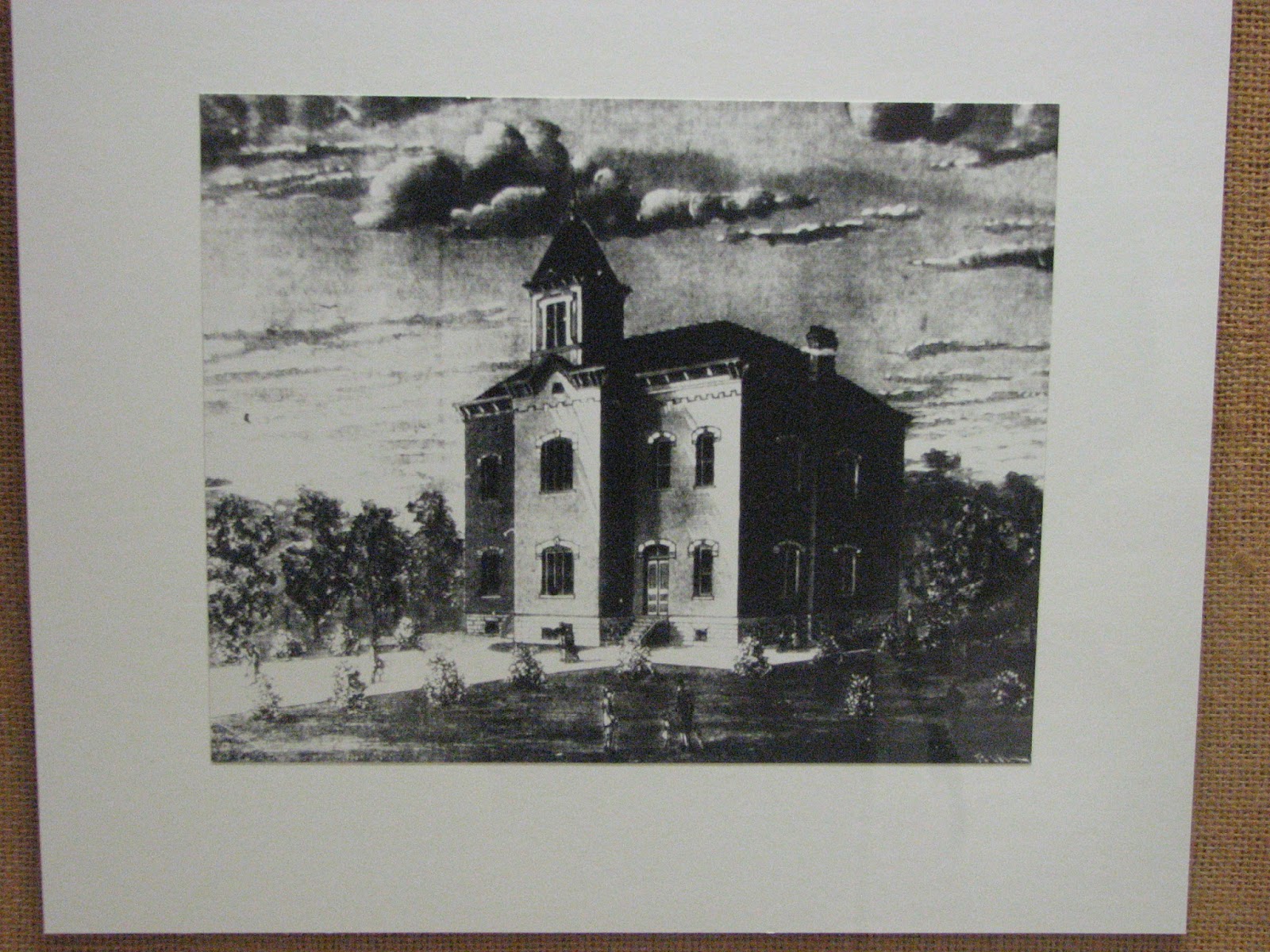
Another pictorial shows the school.

Residents set aside 10 acres for the cemetery. They definitely expected to get the county seat honor.s Here's what it would have looked like. A quarter of the cemetery was designated for the town's African American settlers.
Some of the graves are cracked. Some have been stolen over the years.


The cemetery's condition isn't great. But a man named Price Gibbons set up a fund for upkeep before he died a few years ago.


The stone for Jane Martin rests against a tree.

I believe her name was Lizzie Eisenhour.

One of the few graves still standing - His name was Miles.