Showing posts with label ghost town. Show all posts

Saturday, March 12, 2016

Nonchalanta - a Dead town in Ness County.

The Nonchalanta hotel
A big thank you to Tom Reed, who hails from the ghost town of Ravanna in Finney County, Tom McCoy of Ness City and Harlan Nuss, who rents the pasture where Nonchalanta once thrived.

They gave me a great tour of the ruins here. They were kind enough to spend much of the afternoon talking to me and showing me around. 

Remember, this is private property. No trespassing!

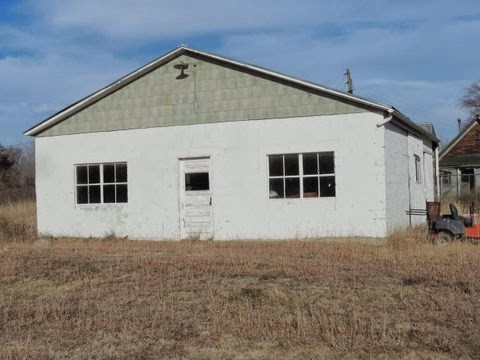
This old stone house was once the site of the Nonchalanta post office.


Just give it a "d---" name
With the promise of free land, Fred Roth and his family came in covered wagons from Missouri to Ness County.
So did others. John Silas Collins, a circuit-riding Methodist minister, who arrived in 1879 and began work to prove up his homestead, according to an article by local historian, the late Jan Gantz, which was published in the Ness County News.
They began building sod homes and plowing up the grass. 
With pioneers came the need for a town. Homesteader Lewis Odom in 1885 decided to plat a town and asked another local, Dr. W.A. Yingling, to come up with a name.
"And I don't care a d--- what kind of name it is, just so it's a taking name," Odom told Yingling according to several historical articles. 
So, as the tale goes, Yingling called it Nonchalant, after the French word of that very idea, and then decided to add the "a."

Odom loved it and began promoting Nonchalanta with the idea the railroad was coming. One newspaper printed on May 23, 1885: "New town of Nonchalanta laid out." By September, lots were reported to be selling for $15 to $85, according to the book "Ness, Western County, Kansas" by Minnie Dubbs Millbrook.

Momentum continued and folks prepared for a promised railroad. Nonchalanta would soon have a livery, a drug store, three-story hotel, real estate office and a general store, Gantz wrote in her article. There was a Methodist church and newspaper. A quarter-mile away, a man named McCandish operated a small country store and post office that the government had previously dubbed Candish. By 1887, the post office was renamed Nonchalanta.

Photo courtesy of Cheryl McVicker Lewis. This is the Nonchalanta school. Her grandmother, Annie Slagle McVicker, was the teacher and Annie's siblings are in the photo.
In fact, said Wichita resident Cheryl McVicker Lewis, whose family homestead in the area, the Nonchalanta newspaper from August 1887 showed 22 businesses advertising in it. 

"And it said there were also several more carpenters, two more blacksmiths and several stone masons and plasters," said Lewis, who grew up near the town site and has researched local and family history. "There were plans to build 100 houses in the next six months."

Folks had began construction on the bank, as well as more stores, restaurants and a Grand Army of the Republic post. There was even talk of a summer resort called "Wildhorse Lake" - located around a natural depression where the wild horses would water, wrote Gantz.

Gantz also reported that lots were advertised in Folsom Heights - "a beautiful suburb overlooking the city."

Great tour by Tom Reed, left, Harlan Nuss, center, and Tom McCoy.
And, in 1887, according to the book by Millbrook, the newspaper advertised the town as "the magic young city of the plains, with six public wells with pure water, a hundred houses to be built in early spring and a railroad to be built during the coming summer."

Sam Howell was one of the business owners. According to family history, he worked on the railroads across western Kansas, drove freight and was employed on area ranches before homesteading and starting a feed store in Nonchalanta. 
There he met Susie Helen Corbet, a young girl working at the Nonchalanta hotel, which was operated by John Rogers, a man who would later become governor of Washington, according to Corbet's writings discovered by Lewis.

Susie and Sam married in Nonchalanta in April 1888 - the same year the school was finished.

The town was buzzing. 

"Dancing, baseball games and picnics were part of the entertainment," wrote Gantz. 
Nonchalanta Methodist Church. It was founded in 1887 and had a minister until 1918. The church continued with a Sunday School until 1925. The building was sold and moved to Ness City.

Wednesday, December 23, 2015

"Eliza - A Generational Journey" - Morton City - an exoduster community


 Crystal Bradshaw's book chronicle's her five-great grandmother, who was a slave for 40 years. Eliza Bradshaw was part of an exoduster group in the late 1870s that helped the now defunct town of Morton City in Hodgeman County.

Courtesy of Crystal Bradshaw

It seemed, at first, that Eliza Bradshaw’s life was long buried beneath her tombstone in the town cemetery – which just marks her birth and death.
Crystal Bradshaw knew her distant grandmother was born into slavery. She knew Eliza was an exoduster who came to Hodgeman County with her family and 100 others in search of a life free of racism and poverty after the Civil War. On the sparsely populated, windswept prairie, they began building a small community they called Morton City.
But when Crystal was tasked to research her family history for one of her high school classes at Hodgeman County High School, she found few answers.
Courtesy of Kansas Memory
“A lot of people in my high school class knew about their family members but not many in my family knew where the Bradshaw side came from,” said Crystal, 21, now a junior at the University of Kansas.
For the past five years, Crystal has been combing newspaper articles and research papers to learn more about her family’s past. She compiled her information into her first nonfiction novel – “Eliza – A Generational Journey,” which she self-published this fall.
She saved her money from her three jobs to publish 50 of the 133-page books. Crystal works as a resident assistant in a college dorm and as a communications specialist and office manager for The Project on the History of Black Writing – part of KU’s English Department. She also earns money as a writer.
In the book, Crystal preserves the highs and lows of Eliza’s life journey – which parallels a harsh time in history.
Eliza was born a slave, growing up in poverty in a one-room cabin with no windows. At age 7 she was sold to another planter. At 17, she was sold again to a cruel slave owner. There were beatings. There were sorrows.
Courtesy of Crystal Bradshaw
And, even when freed, Eliza and her family faced more challenges because of their race and their new found freedom.
Crystal was shocked when she began delving into Eliza’s story, but was also disappointed that it had nearly faded away as the years went by.
“How do you let this rich history just slip away?” Crystal asked, adding. “That is why I didn’t want to just compile my research. That is why I wanted to write a book to preserve it so future Bradshaws can go and see where they came from.” 
To read more of Crystal's story, click here.

Friday, December 18, 2015

Morton City - a dead exoduster colony in Hodgeman County

In the years following the Civil War, a couple dozen black colonies dotted Kansas.

That included a short-lived settlement in Hodgeman County.

After Pap Singleton established Nicodemas in northwest Kansas, exodusters arrived in Kinsley in March 1878. They headed into Hodgeman County and began to form Morton City, which they named after Oliver P. Morton, according to the book "Exodusters: Black Migration to Kansas After Reconstruction" written by Neil Irvin Painter.

Benton Butler, James Board, Carrell Lytle, George Perry, Frank Harris and William Maxwell were black Union soldiers who moved to Hodgeman County sometime in the 1870s, according to a February 2003 article in The News. They are buried in the Jetmore cemetery with other pioneers. The men and their families were part of an early surge of migration before the "Great Exodus" from the South in 1879.

Most who left during the exodus were responding to the South's reconstruction, which resulted in violence and economic dependency for black residents, said Rita Napier in the article, who was then an associate professor of history at the University of Kansas.

A dream of free land spurred them on. Under the 1862 Homestead Act, the federal government provided acre to any settler, regardless of race or sex, who improved the land for five years.

"This is to lay before your minds a few sketches of what great advantages there are for the great mass of people of small means that are emigrating West to come and settle in the county of Hodgeman," one poster advertised. "And more especially the colored people, for they are the ones that want to find the best place for climate and for soil for the smallest capital."

Migration was led by Thomas Moore, said Crystal Bradshaw, 21, who wrote a book about her family history - which traces her five-great grandmother Eliza from slavery to Kansas.

According to Painter's book, the homesteaders had a hard time building the settlement and taking care of their homesteads. Eventually, they focused on just their homesteads.

However, only one settler, equipped with a team of livestock, could grow crops. Others had to make due with gardens and hiring themselves out to the area's established farmers.

Most of the settlers moved away - scattering to nearby communities, said Mary Ford, with the Haun Museum in Jetmore.

Wilburn Bradshaw continues to farm in the area, Crystal Bradshaw said. 
Crystal Bradshaw will have a book signing for her new book, "Eliza: A Generational Journey," from 1 to 3 p.m. Dec. 22 at the Hodgeman County Museum. 
Refreshements will be provided. 
The books costs $14.95; the ebook is $9.95. To order the Kindle version, visit http://hutch.news/Bradshaw. Or visit Crystal's Facebook page at www.facebook.com/CrystalBradshawWriting.


Wednesday, July 29, 2015

A little family history from Corwin, Kansas - a dead town in Harper County

Desiree (Kirby) Rahman
Ingram homestead in NW Oklahoma c. 1897 - 1900  
Often after my dead town stories are published, I get tidbits from people who had relatives in a particular town. 

That was the case with Corwin, my latest story. The Harper County town today is a shell of its former, vibrant, self.

Here's some info and photos sent by Desiree (Kirby) Rahman. Rahman grew up in Hutchinson and her mother still lives in town. Here grandfather was the well-digger's grandson mentioned in the story. 

Here's what Rahman sent:

Charles Ingram's family, c. 1910 
The family moved to Alfalfa County, OK in 1895, after the Land Run. Here's a little more about Charles Ingram. Everything I have always says the family lived in Anthony, but apparently they were in Corwin... My grandmother was born on the farm shown in the "homestead" picture. If you look at the woman in the picture (my great-grandmother) she may be pregnant - if so, I'm guessing that she is carrying my grandmother which would date the picture as 1900. I don't know this for a fact, but it makes a good story!

Text from newspaper clipping, name of paper & date not included, probably The Cherokee Messenger & Republican, Cherokee, OK, Fri Jan 18, 1935

Mr. and Mrs. C. M. Ingram Observe Golden Wedding Anniversary January 13th.
Sunday, January 13, the children and Mr. and Mrs. C. M. Ingram gathered at the farm house five miles west of Cherokee, in honor of the fiftieth wedding anniversary of their parents.

Mr. Ingram and his wife, who was Miss Cynthia Millay, daughter of Rev. and Mrs. D. W. Millay, were married January 15, 1885, at the home of the bride’s parents, near Coloma, MO. Dr. S. D. Millay, grandfather of the bride, performed the ceremony.

The newly married couple left soon for Anthony, Kansas, where they made their home for several years. In 1895, Mr. and Mrs. Ingram, with their four children Edwin, May, Ida, and Edith, moved to the farm which is now their home. Here, the two younger children, Pearl and Charles, were born.
Mr. and Mrs. Ingram were typical pioneers. Mr. Ingram is widely known in this section of the country, having drilled wells since locating here; also being in various business enterprises and politics...

To read more on Corwin, click here.

Wednesday, July 22, 2015

Frederick, population nine, lingers as Rice County ponders town's future

Frederick, Kansas, population nine or 10, on a good day. 


I got an email in early June from a resident in the small town I live in. She said her aunt, Wanda Plautz would be excellent to talk to about the history of Frederick, Kansas.

But my research lead me to a deeper story. The town has been incorporated since the late 1800s. Now the third-class city of just nine residents must decide if it will live or die.

No one ran for election in April. Moreover, no one voted or wrote in a name. There is no official mayor or council.

Here's an excerpt from my story:

Frederick is on life support. 
Melode Huggans knows this. She's seen the signs since she was a little girl, visiting her grandparents, who lived on the same parcel she does today.
The school at Frederick
The schoolhouse is empty − stripped of its desks. A jail cell sits in the middle of a field of wheat stubble, the metal bars and innards rusting. Old playground equipment and paint-worn cars are barely visible amid the trees after decades of neglect. 
Now loved ones like Huggans are faced with a difficult decision on whether it is time for this town to face a natural death.
Ten people call Frederick home − on a good day, that is. It once had as many as 150 people, along with grocery stores, a lumberyard, blacksmiths and restaurants. 
Yet, on this July morning, Huggans pointed up an empty street in front of the home she and husband, Steve, have lived in for 19 years. This was the main thoroughfare, she said. But every business has vanished. There isn't even a foundation left. 
Frederick, an official Kansas third-class city, is almost a ghost town. 
In the April election, no one ran for mayor or for any of the city council seats. Not one resident wrote in a name, either. In fact, it appears no one even voted.
The old jail still stands
For the first time since the town's inception in 1887, Frederick has no leaders. The town's budget is due Aug. 25.
At a recent Rice County Commission meeting, commissioners and the county clerk discussed if it is time the town calls it quits and unincorporates. 
Huggans doesn't know the answer. She serves as the Frederick city clerk, but isn't sure the next time the former council will meet. Her husband is on the city council. But their thoughts have been on other things. Melode has been battling breast cancer, diagnosed in April.
Frederick, however, is a part of her life. 
"My grandparents lived here," she said. "It was a town when they lived here. My mom was born here, went to school here."

To read the rest of the story and see more photos and a video, visit www.KansasAgland.com


Monday, July 20, 2015

Corwin, Kansas, a dead town in Harper County


Rice County farmer Delmar Conner dropped by a book a couple years ago on the history of Corwin, Kansas.
He wasn't from Corwin, but he thought it sounded interesting.


So, on a hot June morning, on my way to a wheat field near Kiowa, I ventured to the tiny ghost town.

There isn't much there. And what is there is blocked out by trees. That includes the school and a few homes.


I was greeted by an elevator employee, who said he had been interviewed once before, when the nearby town of Hazelton was evacuated for a gas leak (or something to that affect.) He directed me down the road to Monty Whitaker, who has lived in the town for more than 20 years.


He estimated about 10 people live in Corwin, which includes a son and family.


Corwin once had grocery stores, blacksmiths, church and the bank. It had a school and an assortment of houses with families. The elevator, however, is the only business remaining.


To read about Corwin, visit our website, KansasAgland.Com. Here's a link to the story and photos.


Friday, March 20, 2015

Kiowa County dead towns: Reeder, Janesville, Brenham


Greensburg resident continues search and digging around several long-dead towns


GREENSBURG - Traveling down a dirt path sandwiched between a wheat field and pasture, Ed Schoenberger abruptly motions to stop the car.

"You're now in downtown Reeder," he says as he steps out of the vehicle - facing the cold wind that whips across the wide-open prairie on this early March day.

But all around him, there is nothing here but farmland and grass. Reeder, once a bustling community where residents dreamed of a railroad, has disappeared.

Underneath the ground, however, the memory of Reeder still exists. Reeder began in 1885 but only lasted a handful of years, with the post office closing in 1891. The railroad never came, and the community eventually died with its remains buried in shallow graves below the prairie grass.

Schoenberger pulls out his metal detector and begins finding century-old trash - largely sardine cans that settlers left behind.

Reeder's tale mirrors countless towns across Kansas, including several in Kiowa County. Schoenberger has been working to preserve those memories through his research and amature archeolgoy.

Meanwhile, Schoenberger is also researching the towns of Janesville, Brenham and others, finding artifacts along the way.
Greensburg resident and historian Ed Schoenberger uses a metal detector to find items at at the townsite of Reeder. 


Sardine cans and fruit cans were common in the 1880s and are often found when metal detecting around townsites.

Sunday, December 28, 2014

Saunders, Kansas, a dead town in Stanton County


Looking into Kansas. Saunders is in the background

Saunders, notice the dust storm haze.


The little border stop greets you as you enter Kansas -- along with a windshield of dust.


And on this late summer day, it seems, the dust is especially bad at Saunders, which sits right next to the Colorado border along a stretch of Highway 160 that, for miles, is nearly empty of people.


But for Minnie Watson, the whirling earth she experienced here during the 1930s was much worse than today. She and her family moved to Saunders in 1937. She was in second grade.


Her family had left Plains, Kansas -- an area still plagued by dust storms, although it wasn't quite in the heart of it like Stanton County. In a time when jobs were hard to come by, her father had secured the position of elevator manager for the Collingwood Co.


They moved into Saunders' single residence, which also was the elevator scale house and office.


Here, their power was from the wind, she said. While they had enough for lights and radio, it wasn't enough, though, to power a refrigerator or washer, which they had left behind at Plains.


It took a little while for the family to adjust to the stark landscape. Upon seeing their new home, "my mother cried and cried."


"It wasn't quite as dusty at Plains," Watson, 86, of Manter, recalls. "But at Saunders, it was just dirt."
To read the full story on Saunders, click here.

Monday, September 29, 2014

Yankton, Kansas a defunct town in Harper County

Photos by Sandra Milburn. Concrete still remains at Yankton townsite
A few clues about Yankton
I got an email after the 2014 Kansas State Fair from Dan Stringer, who said he once lived at the townsite of Yankton in Harper County. So, photographer Sandra Milburn and I picked Stringer up where he was living in Argonia and trekked to the former townsite near Attica. 
Harper County has more than 30 extinct villages – towns like Joppa, Pilot Knob, Shook and Ruby, according to the Kansas State Historical Society. While some have chronicled histories, the details of Yankton’s brief existence are few. There is no evidence of its birth or how and when, exactly, it died. 
        There are some clues however. 

Perhaps the town was started by the Oliver family. According to the book “Harper County Story” written in 1968, Yankton was a pioneer village in Ruella township. It had a post office, which opened Aug. 6, 1883. The postmaster was Stephen C. Oliver. He also owned the Yankton Hotel, livery and stable. 

Meanwhile, Marcus Oliver,   postmaster Oliver’s brother, was in real estate of the town, having “a number of city lots for sale cheap,” according to the book. He also ran a peanut stand in connection with his real estate business on the north side of the Yankton square.
Yankton even had a newspaper, the Yankton Gleaner, an eight-page paper devoted to Yankton and its vicinity. It sold for $2 in advance.
And, for a time, people came to the area and settled here, calling Yankton home. A.J. Barr was a bricklayer, plasterer and sod carpenter. R.S. Sullivan was a shoemaker and cobbler. L.A. Jones was a hairdresser.
There was also Dr. Joseph Brockway. He settled with his wife and six of his children – noting in a letter to family that his daughter was at a university in Iowa.
His family’s roots are deep, he wrote to the receiver – noting his family history goes back to “the Massachusetts colonial tradition.” Two family members were massacred at a fort on the banks of the Connecticut River at the close of the Revolutionary War, he wrote.
The letter, the property of the University of Kansas’ Kenneth Spencer Research Library, was dated May 1884 and gave no details about life in Yankton, except to mention he was writing from Yankton in Harper County, Kansas. Brockway did write that he hadn’t finished his doctorate and was taking classes at Ann Arbor University.
There are few mentions of Brockway in other publications. One genealogical document noted he also was an attorney. The Annual Report by the U.S. Bureau of Animal Industry lists Brockway fighting southern cattle fever on his farm south and west of Harper along Nine Cottonwoods Creek in 1883.
Brockway must have eventually left Kansas, although I'm not sure when. It could have been after Yankton's demise. An obituary for a Dr. Joseph Brockway in the Wichita Daily Eagle published in May 1911 said he died in Aline, Oklahoma, which is about 70 miles from Yankton.
Then the trail of Yankton’s story runs cold. Brockway’s obituary never mentioned Yankton. Even Postmaster Oliver’s obituary never mentioned Yankton or his time as a postmaster. It said he settled in the Attica area, just two miles to the west of the Yankton townsite, in 1882. He is buried in the Attica Cemetery.
What little details there are show the town was short-lived. The post office closed one year after it opened in October 1884.
Stringer said the stories he heard was Yankton was near the site of an Osage Village. In Souix and Osage, the name means “village at the end.” Yankton residents planned for a railroad. However, the tracks were laid to the north, going through the nearby town of Crystal Springs, instead.

On our trip to the site, Stringer pointed out where he and his second wife, Phyllis, lived. It was once the Yankton hotel and saloon, with a brothel upstairs, he said. They ran a Christian ministry from the site, which is now being used by a local church.  

To read the whole story on KansasAgland, click here

Friday, August 8, 2014

Feterita, Kansas - a dead town in Stevens County

Stevens County Sheriff Ted Heaton and his family are the last residents of Feterita, a dead town in Stevens County. Here's a little history on the town that thrived for a while in the 1910s and 1920s.

Photo By Calvin Mathis


Meadows to Feterita
It was an era where towns were established about every 10 miles - the distance a farmer could typically travel by horse and wagon in a day to do business. In addition, one thing that helped secure the location of a town was whether it would get a train.
The train came through in 1913, according to an article written by longtime resident Susie Ausbun in the book "The History of Stevens County & Its People."
"All the farm people and our entire school drove up to see the first train go through. It was traveling so slowly with all the railroad VIPs on it. People were walking behind, some had trailed it from Hugoton."
With the train, a town was planned about seven miles west of Hugoton, Ausbun wrote. Organized around 1918, it was originally called Meadows and was platted under that name.
"We had a big celebration, people came from all over the country when we auctioned of lots to form the town," Ausbun wrote. "For every 25 lots sold, one was given away to names drawn from a large box. Anna Nichole, my sister, won one."
According to the June 21, 1918 edition of the Hugoton Hermes, "The opening of our new neighboring town, Meadows, was a success. Business lots sold for from one hundred to two hundred dollars. Residence lots sold for twenty-five to seventy-five dollars. There is a new Farmer's Equity Elevator and a switch almost completed. Stakes are on the town site at present, but construction will begin soon on several buildings, and Meadows will soon e a thriving village."
Photo by Amy Bickel
People began to build on their lots, Ausbun wrote, noting, "Many little shacks went up." A store opened on Main Street.
However, when the post office organizers wrote a letter to the government to get a permit to open, they heard back that there was another Meadows.
"After a lot of discussion, the name Feterita was passed by the post office department. Feterita was the name of a grain crop raised at that time in the area. A lot of people were disappointed in the name and the town was still called Meadows for a while then Feterita began to become familiar."
The post office opened in 1919 but closed in March 1920. It reopened in December 1922 but closed again by April 1937.
"I can remember a little grocery store over there and two elevators and a family or two lived over there," said Gladys Renfro, who helps run the Stevens County Oil and Gas Museum. "All the people who lived there are all gone."
Shirley Kramer, who farms with her husband, Jim, in the area, said her mother was Ausbun who wrote the history.
She said when she and her family would go by Feterita, "we used to laugh we were going to Feterita Junior College."
Except for a small elevator operated by Elkhart Equity Exchange, there hasn't been anything happening at Feterita in his lifetime, said Neal Gillespie, director of the Stevens County Economic Development.
"In my lifetime it has been a bump in the road," Gillespie said.

Saturday, May 10, 2014

A little history on Fort Zarah, Allison Ranche and the town of Zarah - Barton County, Kansas


Photographer Lindsey and I ventured here more than a month ago. We found little left of any of the sites, although we really didn't know where to look.

I want to thank Robert Yarmer for his help in sharing his wife's family history. Here's a little bit from my latest dead town story.


In the summer of 1855, when prairie pioneers Williams Allison and Francis Booth came to what would someday be Barton County, there was nothing here but windswept prairie, Indians and buffalo along with the occasional schooner heading toward Santa Fe on the Santa Fe Trail.
Fort Larned wouldn’t be established for another few years and there was little settlement west. Nevertheless, the two men decided to build a settlement along Walnut Creek on the trail – offering supplies and respite to those making the journey.
These days, there is little left of the settlements that sprang up along the trail just east of Great Bend – a few stones in a field, remnants of dugouts and a handful of civilian graves deep below a field of greening wheat.
The autumn 1966 cover of the Kansas Historical Quarterly features a water color of Fort Zarah on the Santa Fe Trail as illustrated by Henry Worrall.
Allison Ranche, along with a town of Zarah that would develop a short distance to the north about 15 years later, have both disappeared – meeting the fate of more than 6,000 other settlements that once populated the state in the latter half of the 1800s.

A trading post
William Allison, a man with just one arm, and Francis Booth had become familiar with the route as former conductors of the monthly mail, according the Kansas State Historical Society. They had encountered Indians along the trail and knew of the hazards of the prairie.
Therefore, 132 miles beyond Council Grove, they established a trading post on Walnut Creek, located in the domain of the nomadic Plains Indian tribes and of the buffalo range.
The July 1855 issues of the Independence, Mo.-based publication, the Occidental Messenger, gave this account of the pioneers.
‘Mr. Wm. Allison and Booth, known as famed prairie men, have determined to make a settlement at Walnut Creek on the Santa Fe road. A short time since . . . they started on an expedition to the gold region; their mules and provisions giving out, and not being able to purchase any on the road from any train, they abandoned the idea of going further toward the Wichita diggings, and returned here, determined to settle on Walnut Creek. Booth left a month or two since, and Allison this week, and from last reports of Booth’s progress, he was busily engaged in building houses and corrals.
This is the first attempt at building by citizens made West of Council Grove, and we hope it may grow up in a short time a flourishing settlement. The men at the head of this enterprise are well known here, and distinguished for their energy and determination, they have no fear about them. ... This settlement will be another stopping point on the route to New Mexico and will make, in a little while, the road less dangerous by lessening the distance between civilized points and affording those in danger or want an opportunity to obtain relief.”
On August 25, the Occidental Messenger also reported that Allison and Booth’s post was nearing completion, with the men hoping to open trade to Indians and any travelers who needed “provision and aid as they journey.”
In December 1856, a post office was established at the ranche, with Allison as postmaster, according to the historical society.
In February 1857, the Santa Fe Gazette published this notice that Allison and Booth had established a trading house and general depot at Walnut Creek on the trail, having on hand groceries, provisions, forage and corrals, according to the historical society article. However, by September, the partnership ended. An article in the Santa Fe Gazette a month later reported: The Mexican who brutally murdered Mr. Booth and Walnut Creek last month, by splitting his head open with an ax, was arrested in San Miguel County last week.”
Meanwhile, according to the historical society, Allison continued to prosper as train traffic boomed. Those venturing toward Pikes Peak in search of gold took the mountain branch of the road to head to Colorado.
Despite his success, Allison died in 1859 of heart failure.

Peacock and Rath
Following Allison’s death, George Peacock took over the ranche.
Peacock’s time at the post, however, was short. Kiowa war chief Satank was arrested after almost passing out from drinking too much at Peacock’s post. Satank escaped but asked Peacock to write a letter of introduction saying he was a good Indian. Not counting on Satank having the letter translated, Peacock instead headed warning to those who read it – saying the Indian was treacherous and dangerous.
According to the state historical society, in the fall of 1860, Satank led warriors to the ranch and killed Peacock and five other men and stole all of the livestock.
Trader and buffalo hunter named Charles Rath took over the trading post next, and he expanded the operation, even helping establish a toll bridge across Walnut Creek.
Meanwhile, as attacks subsided, the military abandoned Fort Zarah in 1869.

Unearthing remains of the ranch house at Walnut Creek Crossing of the Santa Fe Trail (near Great Bend) as supervised by State Historical Society archeologists May 31, 1969. The photograph was taken looking north along the west footings.
The town of Zarah
Not long after Fort Zarah’s abandonment, a town by the same name was formed on the edge of the fort’s property, just north of Allison’s Ranche, Yarmer said.
It was 1870, says Yarmer, adding his wife’s great great uncle, Titus Buckbee, a cattleman, was one of the founders.
Back then, Yarmer said, “everyone wants to start a town, sell lots and be a mayor. That was where the money was.”
Buckbee had been in the Civil War before venturing west. His prison stay at Andersonville during the war hindered his health, Yarmer said.
Zarah would have a blacksmith, a grocery and a livery, among a handful of other stores. In 1871, Buckbee became the town’s postmaster, becoming the first postmaster since Barton became a county.
It also had a murder. Buckbee’s brother-in-law Zach Light was minding the store for Buckbee when a man came in asking for crackers, according to the book “Deadly Dozen: Forgotten Gunfighters of the Old West, Volume 2” by Robert K. DeArment. The man wanted cheese for his crackers. Light said he had none.
“This is a hell of a town,” the man said, adding Zarah was letting Great Bend “get away with things.”
Light said if he didn’t shut up, he would shoot, according to the book. And he did, hitting the man in the forehead. Light fled and, despite being arrested by authorities, never stood trial for the killing.
The town went on for a time, but Zarah’s existence wouldn’t last. Great Bend leaders were working to gain the county seat title. Formed in 1871, town leaders knew survival depended on whether they could secure the honor. An election in 1872 decided the towns’ fates. Ellinwood would receive 22 votes, Great Bend 144 and Zarah 33.
Also, Yarmer said, Santa Fe Railroad had reached Barton County that year and didn’t put a depot in Zarah.
“Politicians from Illinois – they knew how to grease the skid,” Yarmer said, adding the story is these Great Bend officials “bought cases of whiskey and dined the railroad. Zarah tried to do the same, but didn’t have the moxie to do it.”
Angry, Zarah folks moved most of the buildings to Ellinwood’s downtown. Fires destroyed the buildings, Yarmer said.

Little left
Today, there is little left of this area’s early settlement. A sign on the side of the road near Great Bend tells the history of Fort Zarah, although the park isn’t located on the actual fort site. A display at the Barton County Museum also shows artifacts found from digging exhibitions, Neuforth said.

Friday, February 28, 2014

School photos from Saratoga, Kansas, a dead town in Pratt County

I was cleaning out my email and noticed this old photos of the Saratoga school that was sent to me last summer. To find out about Saratoga, a dead town in Pratt County, click here. A clump a trees at the site mark where the school stood.

These photos are courtesy of the Pratt County Historical Society.


Wednesday, December 18, 2013

Photos of Densmore, a Norton County dead town

I want to thank Lois Archer who provided me with these photos of Densmore. Densmore is in Norton County - a little town where just a handful of people of reside. This ghost town, however, has several old structures still standing, giving those who pass through a glimpse of what was once a vibrant town.

The elevator. It no longer is in operation. The railroad tracks are long gone, too.


Only about four homes are occupied in Densmore. I don't believe this is one of them.


I believe this is the old station/shop.


The Catholic Church. It's among one of the best structures still standing. It closed in the early 1990s.


An old dilapidated home in Densmore.


Here's another one of Densmore's many old homes. It looks like it was really stately at one time.

An old water well - cool.


There are several empty, old houses in Densmore.


Target practice.

Here's the steps going to the Free Methodist Church at Densmore.

Free Methodist Church


Free Methodist Church

Inside the church, you can still see the woodwork.


It appears the church once had a balcony.


Perhaps this area was where the minister stood.


Anyone need to go to the bathroom? :)


Densmore school.

Densmore school. Both the elementary and high school closed in the 1960s. The high school closed first, in 1965.

One of the Densmore schools. What remains.

Densmore school.

One of the old schools at Densmore. There isn't much left.