Showing posts with label ghosts. Show all posts

Friday, December 13, 2013

Densmore, Kansas, a dead town in Norton County


 Marion Wilcox stopped by last summer, wanting me to research his hometown.

It's Densmore, Kansas, several hours from Hutchinson. I haven't been to Norton County in a while - not since a fishing trip three or four years ago.

But Wilcox was persistent, which gets me every time. I began making calls to see if I could find out a little more about this ghost town.


There is not much left. The red brick Methodist Church has long been overtaken by trees.
Other dilapidated buildings line the dirt streets here, including a wooden elevator near where the railroad tracks once lay. The roof is caving in on the bank turned post office, which closed in the 1980s – the zip code still etched on the window. The old Farmers Supply Store is but an empty shell and the high school isn’t much more then rubble. 

In fact, for those still counting, only a handful of people withstand in a town once vibrant with activity. But over the years, one by one, people have sought greener pastures in bigger cities – abandoning the rural Norton County town of Densmore.

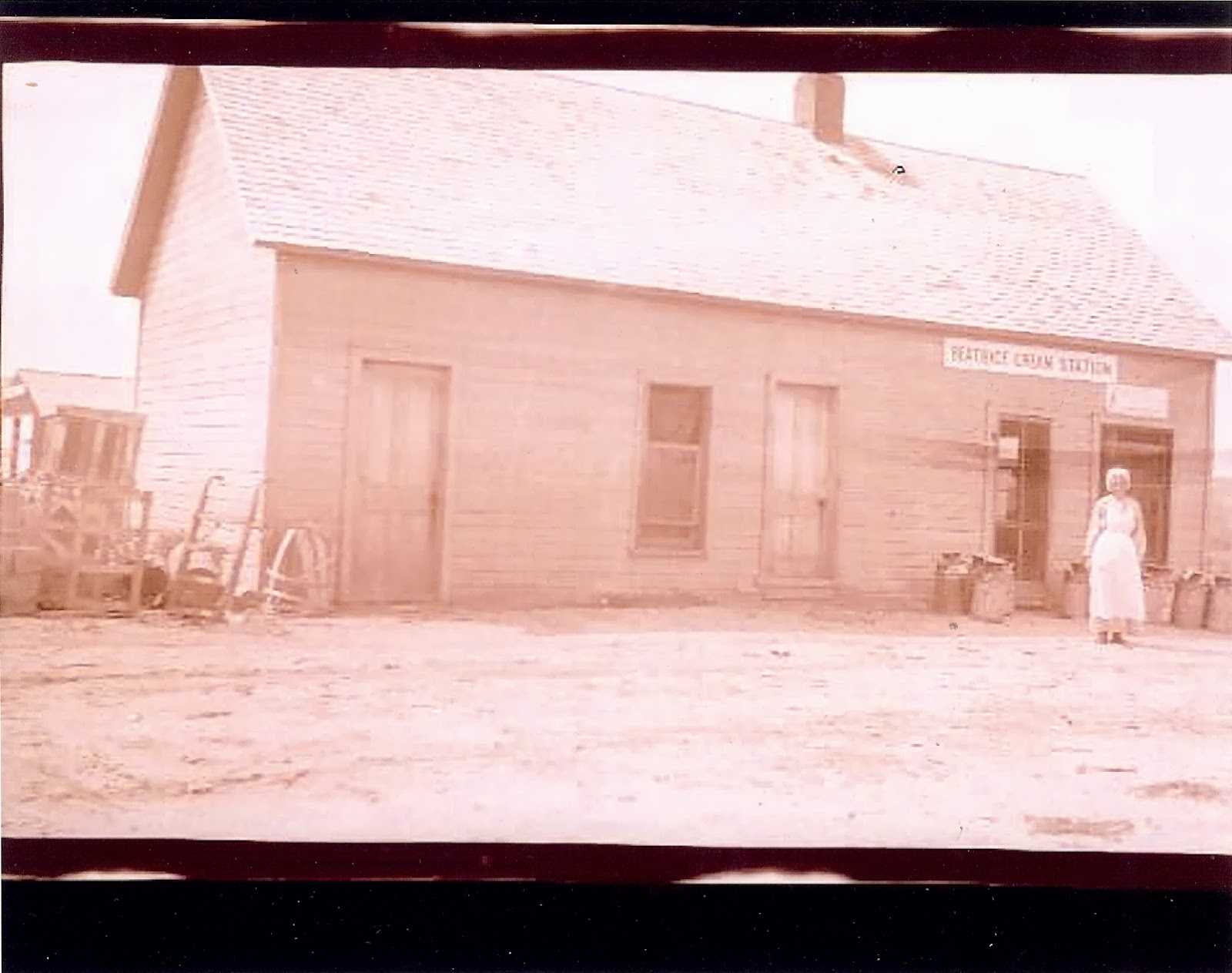
 “There was a hardware and the elevator, a lumber yard and grocery stores,” Wilcox told me, who now lives in Partridge but spent many of his childhood years in Densmore. “We had a post office and a garage. We’d haul cream to the depot – we’d send five or 10 gallons of cream by train a week.”

Yet Wilcox was among the many who left – taking Highway 9 out of town to join the Air Force, then found work in a Hutchinson manufacturing plant.

Here is a little bit of the tale. All photos are courtesy of Doyle and Lois Archer. Doyle grew up at Densmore.


A pioneer named Densmore
Pioneers were still just settling the western Kansas prairie in 1878 when Cyrus Archer came to Norton County. 

Much of the landscape was still rolling waves of grass. But as Archer trekked across it, he saw smoke coming up from the horizon where a dugout eventually emerged, said Doyle Archer of his distant relative. 

There, he met Thomas J. Densmore, a man who had come to the area four years earlier.

At the time, there were a few homesteaders in the area. One, a man named Sorghum Smith, had died not long before Archer’s arrival. Smith had been in a disagreement with neighbors. Four weeks before his death, a note was pinned to his door, signed by 15 citizens who told him to leave the county or he would be mobbed, according to the “The History of the Early Settlement of Norton County, Kansas.”

In mid-April he vanished. Three weeks later, one of Smith’s sons went down into the tunnel which had been dug on his farm where Smith had considered building a mill. He saw his father’s body floating. A coroner and jury were summoned, and they called it a suicide.

Densmore lay claim to Smith’s property and eventually laid out the town of Densmore on the Solomon River. The town began to boom when the railroad came through in 1881, according to an article in the Norton County News that was transcribed by historian Ardie Grimes.

Businesses began to pop up across the little town. There was a hotel, hardware, general store, newspaper and creamer. Densmore himself was the first postmaster in town. Cyrus Archer helped constructed the 
Free Methodist Church and was the first pastor, according to information compiled by Grimes.

The town would eventually have a bank, school and elevator, and, in 1910, it had a population of 100, according “Kansas: A Cyclopedia of State History,” published in 1912. Yet Thomas Densmore didn’t get to see the town’s future growth. A train struck his horse and buggy in 1890 and he died a few months later.

Densmore sued the Missouri Pacific before he died, then his widow took up the suit, according to Grimes’ research. A jury found in favor of the railroad.

Doyle Archer said Densmore had a couple of famous sons, including Glenn Archer, who was born in Norton Count in 1929. He was a senior judge of the U.S. Court of Appeals for the Federal Circuit, a position he was nominated for by President Ronald Reagan.
 

Friday, January 18, 2013

Black Day for News Cameraman - Medora, Kansas

From April 19, 1961 Hutch News
By TED BLANKENSHIP
My "Bad Day at Black Rock
turned out to be a "mad morning
near Medora" Tuesday.
You never know when tempers
will flare and you will find yourself
and your camera lymg in the
muck of the Little Arkansas.
It didn't quite happen, but
there were times when things got
a little uncertain.
An attempt at news suppression
by threat on a lonely railroad
trestle in Reno County was
the last thing I anticipated when
I left my breakfast table Tuesday
morning.
But here's what happened:
I got a call from the editor.
A routine assignment: a teenage
girl had tried to lead a horse
across a railroad trestle, and the
animal had caught a hoof between
the ties.
When I arrived the veterinarian,
Dr. Brace C. Detter Jr., of
Nickerson had given the mare an
anesthetic, and was trying to get
her legs tied so she couldn't hurt
herself.
A group of Medorans, apparently
farmers, was helping. A tractor
was ready to move the animal
off the tracks on a wooden
sled.
No Publicity
"We don't want any publicity,"
said one of the men.
"Here comes a TV man," said
another.
I hastened to point out that I
was from the Hutchinson News,
not a television station.
"You're not going to take pictures
of that little girl's horse,
are you?" another little girl
asked, animosity in her eyes.
"I have a job to do," I replied.
The girl, I determined later,
was Martha Suarez of-Hutchinson.
I then waded across the stream
to get on the east side of the;
group of men so I wouldn't be
shooting against the sun.
One of the men said it was "no
skin off my nose, but it would be
nice if you wouldn't take any pictures."
I again explained that I was
following orders and had to do
my job as best I could. What
was used in The News would be
determined by my superiors.
"Wliy don't you be real mean
and leave it out this time," he
said. After all, those little girls
have had enough trouble for one
day."
By this time Dr. Detter had finished
tying the mare and she was
being loaded onto the sled.
Touch of Sarcasm
"I hope you got all the pictures
you wanted" said Miss
Suarez, a touch of sarcasm in
her voice. "Why don't you go
get a picture of that little girl
crying in the car? That ought
to make you a good front page
picture."
About that time one of the men
working over the horse asked me
how I would like to have him
throw me and my camera into
the mud under the trestle.
I think I am just horse enough
to do it," he said.
I thought to myself that he
probably was horse enough, but
said nothing. I didn't want to
lose my film or my self respect
at the moment.
By this time the horse was on
the sled, and I decided it was
time to leave. I stopped to get
one more picture, and at this
point Miss Suarez planted herself
in front of my camera to blot
the view. It truly was time to
go-As I turned my car around on
the gravel road, I wondered how
much help I would get if I backed
my car into the ditch.
I tried to drive carefully.

Wednesday, October 17, 2012

Rydal, Kansas - a dead town in Republic County


Building the overpass at Rydal in the early 1950s.


Then, in 1950, U.S. 36 highway was built through Scandia township and a new overpass was constructed over the railroad tracks at Rydal. A large park was built for tourists just east of Rydal on the highway.
But the hustle and bustle of the little town would soon come to an end. According to the June 5, 1952 edition of the Telescope, a fire broke out that year at the elevator.

Mrs. Amos J. Dickerman, Rydal, postmistress, gave the first alarm. "I was wakened by a crash like "thunder, and looked out the window. When I saw the sky was clear, I looked to see if a car had wrecked on the highway. Then I saw the glare of the fire ... It was burning all over, with the flames swirling and sparks flying everywhere."
But as crews put one fire out, the hot ashes landed on the roof of the Presbyterian Church, Dooley said. 


1951 aerial of Rydal
Rydal, Kansas, was as ordinary as any town planted in Kansas in the late 1800s.

The Rydal Giants played their regular weekly game of baseball for practice on the home diamond in the pasture near Rydal Saturday afternoon and under their able manager and captain it is safe to say it will soon be in the shape to play any team in the county. - May 31, 1907 
William Johnson, of near Rydal, shipped a carload of hogs of his he was raising to Kansas City, loading them at Rydal Thursday morning. - Dec. 2, 1920
 About 30 from the Rydal community enjoyed a basket dinner at the Rydal church basement. - June 13, 1946


But those taking a trip by the town that seemed to come to life from the pages of the Belleville Telescope will find little left.

Trucks line up for harvest at Rydal, Kansas

Read more of this story by clicking here


1935 photo of grocery store owned by William West. Rydal is a dead town in Republic County. These photos are courtesy of the Republic County historical society

My Dear Santa: - I am a little boy 8 years old. I live at Rydal, Kansas. I go to No. 9 school. We are going to have a program at our school. Will you please bring me a desk with pigeonholes in it and a chair and a storybook? I am in the third grade. I have one brother and one sister. Please give lots of toys and candy and things to the poor children that have no parents. Santa, you are a jolly fellow. The 25th of Dec. is Christmas.Yours Truly -Charles B. Beymer Jr.- Belleville Telescope, Dec. 16, 1910


Tuesday, October 9, 2012

Covert Kansas project has kids learning with eagerness

INMAN - Ghost towns don't have real ghosts, these fourth-graders have learned.

"A town is a ghost town because there is nobody there," said Inman Elementary student Dantlie Raney. "Everybody left it."

It's part of teacher Bentley Richert's Kansas history lesson. Most of his students didn't know the definition of a ghost town, or that Kansas has more than 6,000 of them - towns that expanded with dreams of a future before disappearing from most maps.


However, armed with their iPads, these fourth-graders have a quest to memorialize the ghost town of Covert in Osborne County, which has been dead since the last postmark was stamped in 1966.

"We are going to put the flesh on the bones of Covert," said Kaia Wiggins, 9. "We are trying to find out what happened to the town."


The project started after Kevin Honeycutt, ESSDACK's technology integration specialist, read about Covert's story in the Sept. 30 edition of The Hutchinson News. Honeycutt, on his way to Nebraska to train teachers about using technology in the classroom as part of his job through the educational service center, made a stop at Covert.

To read more of the story, click here