Showing posts with label dead. Show all posts

Friday, December 13, 2013

Densmore, Kansas, a dead town in Norton County


 Marion Wilcox stopped by last summer, wanting me to research his hometown.

It's Densmore, Kansas, several hours from Hutchinson. I haven't been to Norton County in a while - not since a fishing trip three or four years ago.

But Wilcox was persistent, which gets me every time. I began making calls to see if I could find out a little more about this ghost town.


There is not much left. The red brick Methodist Church has long been overtaken by trees.
Other dilapidated buildings line the dirt streets here, including a wooden elevator near where the railroad tracks once lay. The roof is caving in on the bank turned post office, which closed in the 1980s – the zip code still etched on the window. The old Farmers Supply Store is but an empty shell and the high school isn’t much more then rubble. 

In fact, for those still counting, only a handful of people withstand in a town once vibrant with activity. But over the years, one by one, people have sought greener pastures in bigger cities – abandoning the rural Norton County town of Densmore.

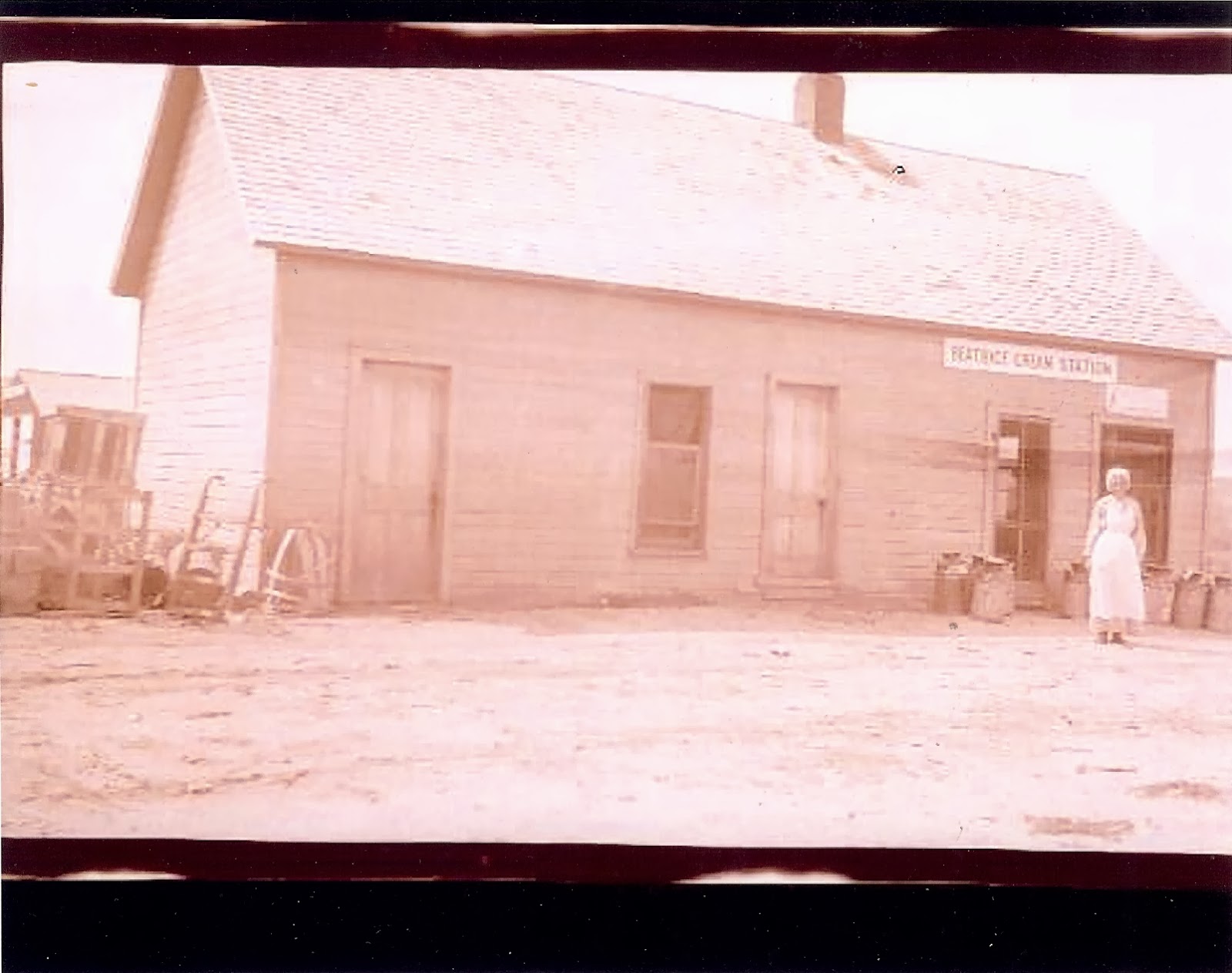
 “There was a hardware and the elevator, a lumber yard and grocery stores,” Wilcox told me, who now lives in Partridge but spent many of his childhood years in Densmore. “We had a post office and a garage. We’d haul cream to the depot – we’d send five or 10 gallons of cream by train a week.”

Yet Wilcox was among the many who left – taking Highway 9 out of town to join the Air Force, then found work in a Hutchinson manufacturing plant.

Here is a little bit of the tale. All photos are courtesy of Doyle and Lois Archer. Doyle grew up at Densmore.


A pioneer named Densmore
Pioneers were still just settling the western Kansas prairie in 1878 when Cyrus Archer came to Norton County. 

Much of the landscape was still rolling waves of grass. But as Archer trekked across it, he saw smoke coming up from the horizon where a dugout eventually emerged, said Doyle Archer of his distant relative. 

There, he met Thomas J. Densmore, a man who had come to the area four years earlier.

At the time, there were a few homesteaders in the area. One, a man named Sorghum Smith, had died not long before Archer’s arrival. Smith had been in a disagreement with neighbors. Four weeks before his death, a note was pinned to his door, signed by 15 citizens who told him to leave the county or he would be mobbed, according to the “The History of the Early Settlement of Norton County, Kansas.”

In mid-April he vanished. Three weeks later, one of Smith’s sons went down into the tunnel which had been dug on his farm where Smith had considered building a mill. He saw his father’s body floating. A coroner and jury were summoned, and they called it a suicide.

Densmore lay claim to Smith’s property and eventually laid out the town of Densmore on the Solomon River. The town began to boom when the railroad came through in 1881, according to an article in the Norton County News that was transcribed by historian Ardie Grimes.

Businesses began to pop up across the little town. There was a hotel, hardware, general store, newspaper and creamer. Densmore himself was the first postmaster in town. Cyrus Archer helped constructed the 
Free Methodist Church and was the first pastor, according to information compiled by Grimes.

The town would eventually have a bank, school and elevator, and, in 1910, it had a population of 100, according “Kansas: A Cyclopedia of State History,” published in 1912. Yet Thomas Densmore didn’t get to see the town’s future growth. A train struck his horse and buggy in 1890 and he died a few months later.

Densmore sued the Missouri Pacific before he died, then his widow took up the suit, according to Grimes’ research. A jury found in favor of the railroad.

Doyle Archer said Densmore had a couple of famous sons, including Glenn Archer, who was born in Norton Count in 1929. He was a senior judge of the U.S. Court of Appeals for the Federal Circuit, a position he was nominated for by President Ronald Reagan.
 

Monday, November 4, 2013

Pictures of Belvidere, a Kiowa County town


Beautiful View

While much of Kiowa County is flat terrain of farmland, the region in the county's southeast corner is an expanse where the sky expands across rolling waves of grass. When the wives of wealthy ranchers Iowa Watson and C.P. Fullington first saw the area, they thought it couldn't be more stunning.

Thus, the two dubbed the town site Belvidere - or "beautiful view" in Italian.

The land had once been part of the Osage Indian Trust, which totaled 8 million acres in a strip extending more than 250 miles across the southern border of Kansas, according to a Jan. 9, 1955, story in The Hutchinson News.

In 1870, Congress assigned the Osage to a reservation in Oklahoma and opened the land to settlement, according to "History of Kiowa County, 1880-1980." A post office named Glick was first established in nearby Comanche County in 1883. It eventually moved near to future town site of Belvidere.

With the railroad coming through, Watson and Fullington, both highly involved in the Greensburg State Bank, along with other interests, began to promote the little town their wives had named.

"Caught in the Boom! Property of the new town Belvidere. $100,000 worth sold in ten days," stated an advertisement in the Greensburg Rustler on May 12, 1887. The ad also said the town was on the railroad and surrounded by fine "bottom farmland."

A year later, the newspaper reported 25 new homes were under construction in the town situated in a clump of elms and cottonwoods along the Medicine River, according to the history book.

Despite its beauty, there was little potable water, Robbins said.

"You could drill a hole in downtown Belvidere and you'll probably find fluid that even a rabbit couldn't drink," he said. "The good water came a little higher."

The railroad began shipping water in tank cars, transferring it to a cistern near the depot, according the Kiowa history book. Crews drilled a well two miles east and eventually water was piped into town.


Thursday, October 24, 2013

Bull: City, a few memories along the way

These stories are thanks to Von Rothenberger. Thanks Von!
The Bull General Store. 
In the fall of 1870 of spring of 1871 General Hiram C. Bull built a rough log building about 12 feet by 24 feet with a shingled roof.  This was divided into two rooms. 
The back room was about 10 feet by 12 feet that had the bed, stove, oil and vinegar barrels and such things.  When they set the stove up the pipe was too short to reach the chimney so they put a box on the floor and set the stove on it, and Mrs. Bull would stand on another box to do her cooking, no place to go for pipe. 
The front room was used for the store; they had a stock of goods, not more than two or three loads that were hauled from Fossil Station (now Russell), at first Mrs. Bull would stay at the store while Mr. Bull went for goods.  When the mail came in every other day it was dumped on the bed and sorted, and put up.  Those days were looked forward to. 
They bought buffalo hides and took them to Russell and Hays and bought goods back.  The General hired George Nicholas to haul for him (he was in the fight with the Indians at Bullocks Ranch, near Osborne). 
The General continued to buy their goods at Russell until 1873.  After that they bought from Drummers, as they were called, from Leavenworth and St. Joseph, but still had to haul them from Russell until the railroad was built.  The first driver for the General was George Witeman.  This George was in the fight with the Indians at Bullock Ranch in east part of Osborne County in 1869, or 1870, and the Indian found down at the stone bluff was supposed to have been killed there.  Later Robert Bates also drove the General’s team for quite a good length of time – had quit to go to his claim just before the General and others were killed, but don’t believe Robert would have been caught in that scrap if he had have been there. 
Many are the stories that could be told of this store and Mr. and Mrs. Bull. 
One day a man came into the door way wrapped in a blanket and carrying a gun.  As he came in the door way the gun caught on the casing and exploded.  They grabbed the man and took the blanket off him and found Joe Hart.  Was hard to tell who was scared the worst.  He never tried that again. 
Cassius P. Austin
*  *  *  *  *
The First Wedding.

      The first wedding in Bull’s City was in the little log store.  The General was the first Probate Judge of Osborne County but there was so little business for Probate Judge at that time that the General did not have to spend much time at Osborne.  This was early in 1872. 
A young German couple over from near what is now Portis came to get a license to marry – but neither were of age so the Judge couldn’t give them a license to marry without their parent’s consent – so they got into the wagon and went home – but the next or second day after they came back, the boy’s father with them.  He told the General he was willing and the girl’s father was also, so they got their license and the General married them – and they climbed into their wagon and started home happy.  A good team and wagon was good enough in those days. 
Cassius P. Austin 
*  *  *  *  *
 A Circus, a Cannon, and General Bull.
In the summer of 1876 (June 3rd) a show came to town.  Two children living about three miles northwest of town were told by their parents that they could walk to town and see the parade and then walk home, three miles there and three miles back.  Who would do that now?  General Bull saw them standing as though they wanted to see the show.  He told them to come in and see the show.  They said they did not have the money.  He said he would pay for them, which he did, and they saw the show, and never forgot the show or General Bull (kids never forget things like that).  These children were Will and Amanda York.
The General saw another group of kids near, who would like to see the show.  He told the ticket men to count the kids as they went into the tent.  When they were all in, the General started away and the man said “Here, pay for these kids!”  The General said, “I did not say I would pay for them, I said ‘count them as they go in!’”  The kids were in and no man could get them out.  He and the showman argued the matter for some time when the General paid the bill – which he intended to do all the time.
The General was planning a Fourth of July celebration one year, and wanted a cannon.  A man living east of town said he had one he could use if he would send a team after it.  The General hired a man and team to go after it.  When he got there the man brought a little toy cannon about 6 or 8 inches high for him to take back.  The joke was on the General, and was he mad.
Cassius P. Austin 
*  *  *  *  *

Bull City: General Bull's Revenge


Gored to death
An avid promoter of western Kansas, H. Bull established a 10-acre elk sanctuary of sorts near his town, said local resident Homer Smuck, also one of Alton's ministers.
"He was a really community-minded man," Smuck said. "He was interested in growing his town and was doing anything he could to make it an attractive place for people to move."
The sanctuary, as Smuck put it, was sort of an early zoo where Bull kept tamed wild animals like elk, buffalo and antelope - all inside a tall, white picket fence.
Rothenberger said the male elk was a special pet that Bull had raised by hand. It was a favorite of the children who loved to hand-feed it.
But everything changed on Oct. 12, 1879.
On that day, hired man Robert Bricknell went to care for the animals when he noticed the male elk was hostile and seemed unusual in appearance. He informed Bull, who said he could subdue the animal.
The elk, which was in rut, charged at the men, striking Bull and knocking him down. He then drew back and made a second attack on Bull, with one of his antlers piercing Bull through the breast. The elk then tossed him into the air and threw him over his head before turning to attack Bricknell.
George Nicholas witnessed the attack and tried to fight the elk with a heavy club.
However, the elk caught the club in its antlers, making indentions in it and rolling it on the ground with great force, according to Rothenberger.
A third man, William Sherman, also tried to help but was tossed over the fence.
"Mrs. Bull was meanwhile a horrified spectator of the terrible tragedy and, wild with grief and terror, ran to the village crying for help," the Osborne County Farmer, reported Oct. 16, 1879.
Bull, Nicholas and Bricknell all died, Rothenberger said. The elk was caught and tied by a couple of ropes to a tree. Mrs. Bull at first didn't want it killed, noting it was an expensive animal worth at least $500.
However, Rothenberger said, once she had calmed down, several men later took the elk and killed him.
The news was reported across the nation. The Osborne County Farmer on Oct. 13, 1879, reported it as an "awful tragedy."
"Gen H.C. Bull, our Honored Representative, gored to death by his pet elk," the headline read.

Name change
In 1885, a Mrs. Clark from Alton, Ill., decided Bull City needed a name change, telling residents such a name was vulgar and no one would want to move to such a city. Residents, loyal to their former leader, weren't supportive.
Clark took matters into her own hands. The names were cut off a road petition and pasted to a change-of-name petition, which was sent to the U.S. Postal Service. Soon, the city was notified its post office was Alton.
It didn't go over well, according to a story by Kansas historian Leo Oliva. Some offered to move their businesses and residences to a new town in Rooks County if the town would be named Bull City.
It was instead named Woodston after a Stockton businessman who offered to donate $500 to a school if the town was named for him, Oliva wrote.
The Antlers that killed General Bull
Today Alton's population remains at 100 people and the little incorporated city is alive and well. It still has a hardware, along with the Bull City Gun Shop and a grain elevator. Only one building still stands from the Bull City days, the 1882 bank building, which housed the post office until last week. An official came and closed the building, saying it was due to deteriorating conditions.